The European Union is calling President Donald Trump’s bluff on his threats of further tariffs amid his continuing—and growing—meltdown over allies refusing to back his war in the Middle East.
“The number one choice is always dialogue,” Kyriakos Pierrakakis, president of Eurogroup, an informal body made up of the EU’s various finance ministers, told Bloomberg Television on Monday. “We want to be a predictable partner in the international economy; we believe in the transatlantic relationship.”
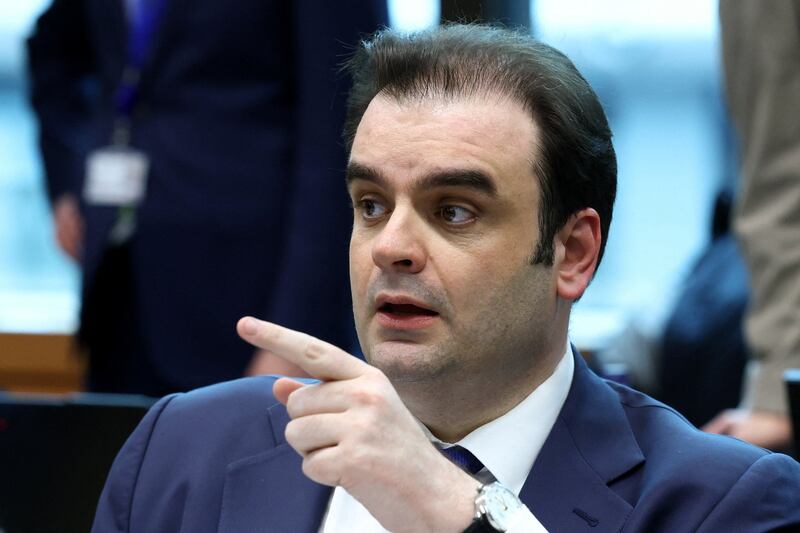
“But having said this, if there is a deviation from what we have agreed upon, obviously all options are on the table and all choices will be on the table,” he added.
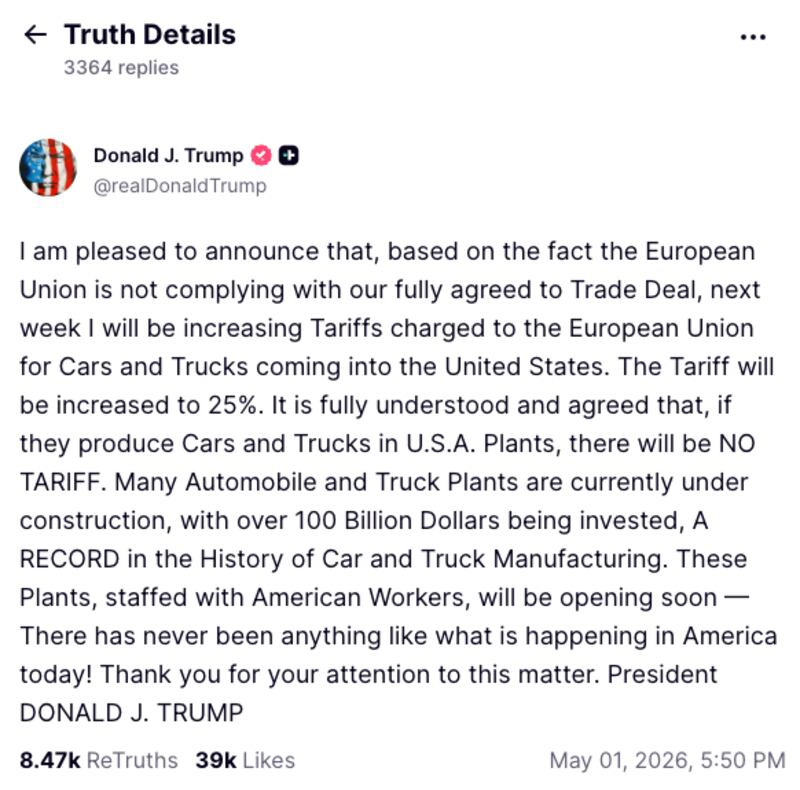
Trump fumed in a Truth Social post on Friday that he’d be hiking tariffs on EU-made cars and trucks to 25 percent because the bloc “is not complying with our fully agreed trade deal.”
The Trump administration struck that deal last July as a solution to the president’s sweeping “Liberation Day” tariffs earlier that April. European lawmakers have since been slowly ratifying the arrangement as they seek amendments to the final version.
Pierrakakis, who also serves as Greece’s Minister of Economy and Finance, conceded that things have not progressed at the pace Trump might have liked, but denied the president’s claims that the bloc is somehow in violation of terms.
“Our side of the bargain has been fully met, has been fully kept with regards to the joint statement commitment and the legislative timetable which we had in order to pass them,” he told Bloomberg.

“We need to speed up, we know that. But there is predictability on our end,” he added in a pointed barb to Trump’s proven lack of that particular quality.
Trump’s threat of resumed tariffs against the EU comes as the president seeks retribution against European allies who refused to back his war with Iran.
The centerpiece of that campaign so far has been his abrupt order last Friday to yank 5,000 U.S. troops out of Germany following a spat with German Chancellor Friedrich Merz.
Merz, once seen as one of Trump’s steadier counterparts on the continent, drew the president’s wrath after saying Iran was “humiliating” the U.S., and that Washington had blundered into the conflict with an ill-advised strategy.

Trump responded within days with a vitriolic Truth Social post announcing the Pentagon was “studying” a drawdown of troops in the country, and the order followed shortly after.
The withdrawal, which blindsided NATO, will leave roughly 31,000 American service members in Germany, down from a Cold War peak of about 250,000.
Trump has since indicated that’s only the start, telling reporters on Saturday, “we’re going to cut way down” and dismissing the alliance, again, as a “paper tiger.”

Germany is not alone in Trump’s line of fire. The president has openly mused about also pulling forces from Italy and Spain. He said he’ll “probably” extend cuts to both because Italy has “not been of any help” and Spain has been “absolutely horrible.”
Spain has denied U.S. forces access to its bases and closed its airspace to American aircraft involved in the Iran campaign, while Italy refused a U.S. request to land military aircraft at a base in Sicily.
In March, Trump further threatened to “cut off all trade with Spain.” A leaked Pentagon email reportedly floated the idea of suspending the country from NATO outright as a way to punish so-called “difficult” allies.
It remains unclear exactly how Trump would achieve that, given that no mechanism currently exists.
The president has also lashed out at the United Kingdom and France, telling the British government in a Truth Social post to “build up some delayed courage” and accusing France of refusing overflight rights for U.S. military supply planes bound for Israel.
The Daily Beast contacted the White House for comment on this story. “The EU should focus on implementing the landmark trade deal it signed with the Trump administration last year,” spokesman Kush Desai said.