
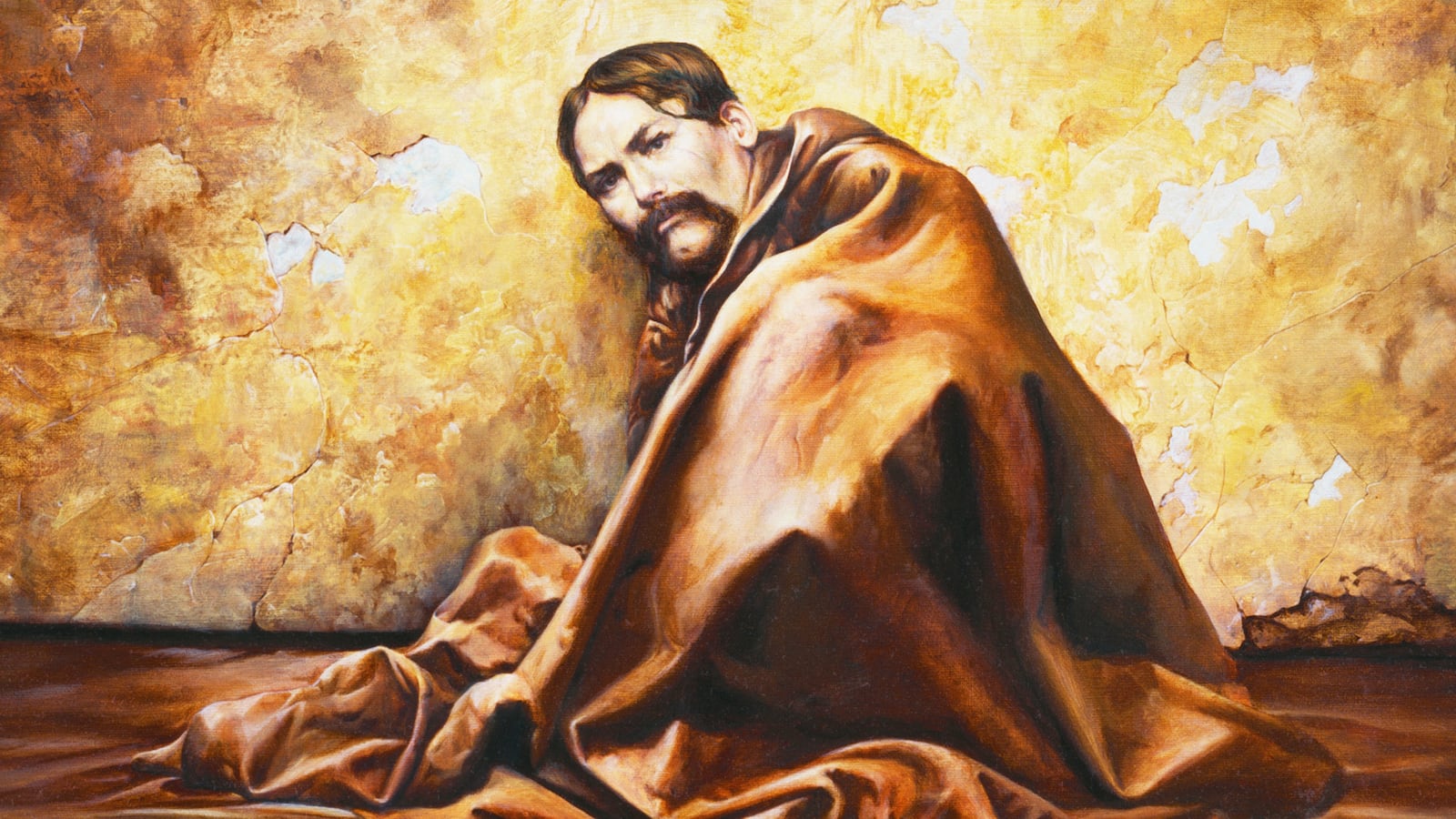
If you were to wander around the cemetery at the St. Mary Magdalen Catholic church in the southwestern suburbs of London, you would come across all the usual sights—burial vaults garnished with crosses, crucifix grave markers that are outright sculptures in stone, and an army of headstones. And then there is the one gravesite that is not like the others.
Against the brick wall that encloses the world of the dead, there is a life-size, 19th-century “expedition-style tent” that serves as a mausoleum for the famed British explorer Sir Richard Francis Burton and his wife Isabel. A glance through the stained glass window at the back of the canvas reveals their two coffins resting side-by-side for all eternity.

It is a rather strange, though fitting scene—one that maintains a customary undercurrent of peacefulness. It is also very unlike Burton in life or death. While alive, Burton was constantly on the move, racking up as many languages and scandals as he did roles—explorer, soldier, spy, writer, poet, publisher, linguist, religious scholar.
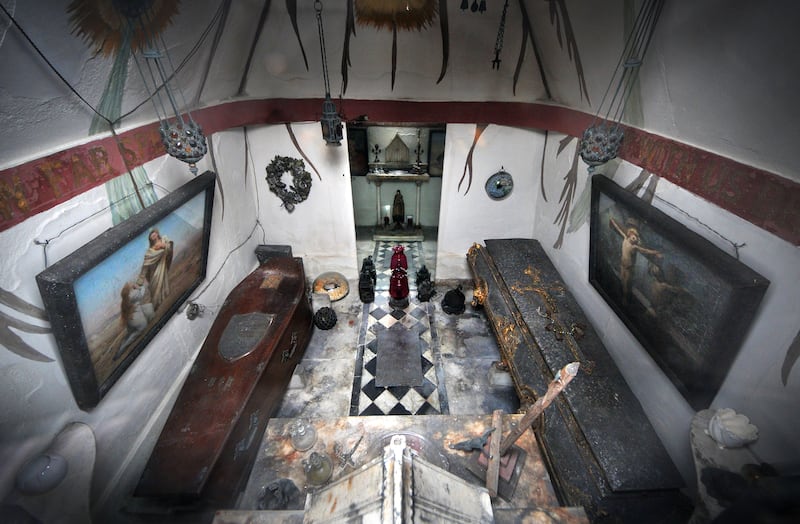
"LONDON - APRIL 11: The interior of the tomb of SIR RICHARD FRANCIS BURTON at St Mary Magdalen Roman Catholic Church, in Mortlake on April 11, 2013 in London, England. Dead Famous London is a journey through the capital's cemeteries, churches, cathedrals, crypts and crematoria discovering its historic famous graves.
Jim Dyson/GettyBut after his death, the role of instigator was assumed by his devoted wife Isabel who ignited a scandal when she burned some of his letters, papers, and, most shockingly, the not-yet-published manuscript of The Scented Garden, the project considered his quintessential translation of an Arabic guide to sex.
Burton was born to be an explorer. His Royal Geographical Society obituary describes a childhood spent “almost constantly wandering” due to his father’s military service and generally “erratic” parents. From nearly his first days to his enrollment at Oxford, Burton was always on the go. He didn’t take to the stationary life of university.
Reports differ as to what exactly caused the dust-up at uni. It may have been horse racing or partying, a deliberate and successful attempt to be ousted or an unintentional byproduct of bad behavior.
Either way, Burton quickly got the boot from the storied institution, which allowed him to resume the nomadic lifestyle to which he was accustomed. He would spend the next five decades exploring the people and planet that so intrigued him.
Burton had an ingenious facility for languages and a genuine interest in the new cultures he encountered. He used his time as a soldier (and spy) for the East India Company to explore India and Pakistan and to write his first travel books. He achieved fame after publishing an account of his pilgrimage to Mecca (in disguise, of course). And and he undertook such feats as (unsuccessfully) attempting to find the source of the Nile.
In his spare time, when he wasn’t exploring the world or questionably infiltrating sacred religious rituals, he also dabbled in translating foreign texts for the English masses. His tastes, especially against the backdrop of the prudish Victorian society at home, ran to the shocking.
He brought editions of the Kama Sutra and The Arabian Nights to England, and, at the end of his life, began working on what Isabel later called his “magnum opus.”
The Scented Garden was the name Burton gave to what he planned to be his ultimate translation of an Arabic sex guide written in the late 15th century by a Tunisian scholar named Shaykh Nefzawi.
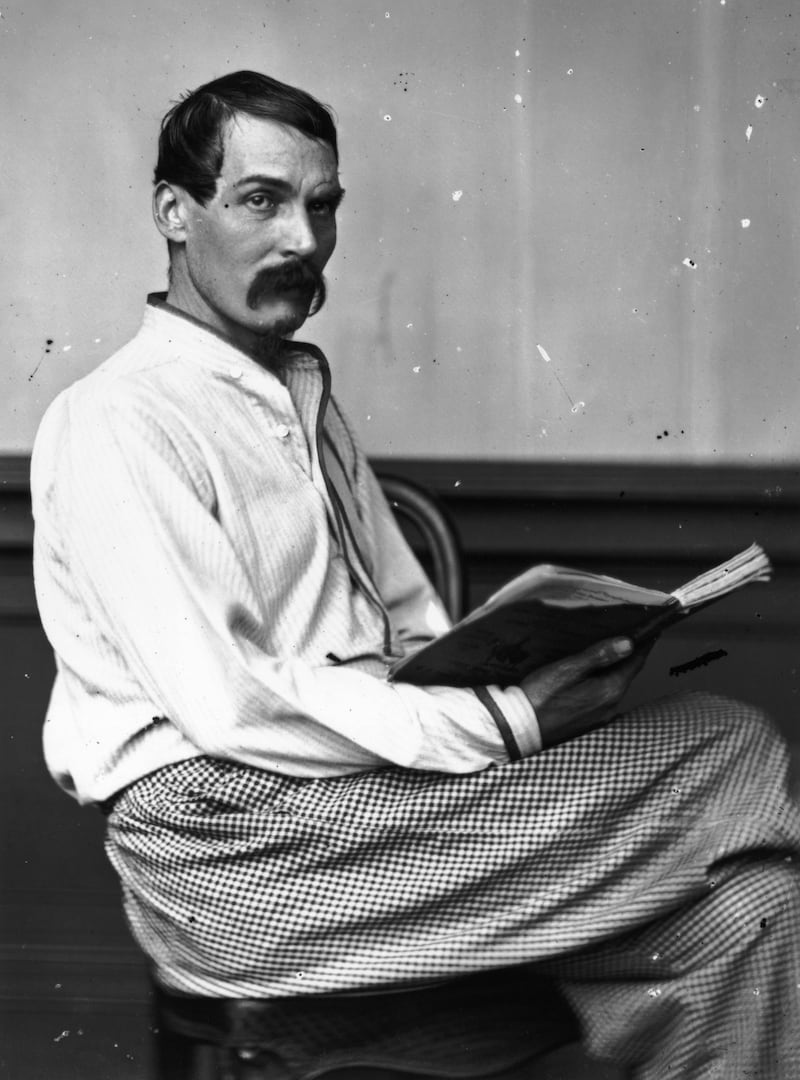
"24th August 1864: Sir Richard Francis Burton (1821 - 1890), English explorer, Orientalist and writer. He translated 'The Perfumed Garden', 'Kama Sutra' and the 'Arabian Nights'.
Rischgitz/GettyThe Arabic book was a similar text to the Kama Sutra, exploring all things concerning carnal pleasure, but, according to Edward Rice in his biography Captain Sir Richard Francis Burton, it took a more sexist approach in which the “woman is not a partner in sex but more of an object, to be used as desired.”
Burton had published a previous version of the text based on a French translation he had stumbled across, but there was something that left him unsatisfied about these reproductions, both of which were titled The Perfumed Garden. He wanted to find the original Arabic text and to make a new, unmediated translation, complete with his own observations and annotations, of course.
On a trip to Algiers in 1889, he finally tracked down a copy of the original and his hunch proved correct: the French version had left a lot to be desired. He set about creating a new, more complete translation, and he called it The Scented Garden.
But on October 19, 1890, Burton’s lifetime of adventure and his role as purveyor of scandalous texts came to an end when he woke up to a heart attack at 4 a.m. Almost from the moment she realized something was wrong, Isabel began making decisions that would continue the scandal that had filled her dear husband’s life.
Burton was a student of religion, particularly those spiritual beliefs that explored the mystical and the occult. But while he studied world faiths, he didn’t hold conventional religious beliefs himself. He described himself as “a Spiritualist without the Spirits.” His wife, however, was staunchly Roman Catholic.
So it was perhaps no surprise that she called in a priest to administer his last rights. When the priest arrived at 6 a.m., it was pretty clear that Burton was dead, but in her hysteria, Isabel maintained that he was merely in a coma. (She also falsely contended that he had recently accepted Catholicism as his faith.) She carried on in this manner until later in the evening when she finally allowed the long-passed explorer to be pronounced dead.
“Losing the man who had been my earthly God for thirty-five years was like a blow on the head, and for a long time I was completely stunned,” Isabel would later write.
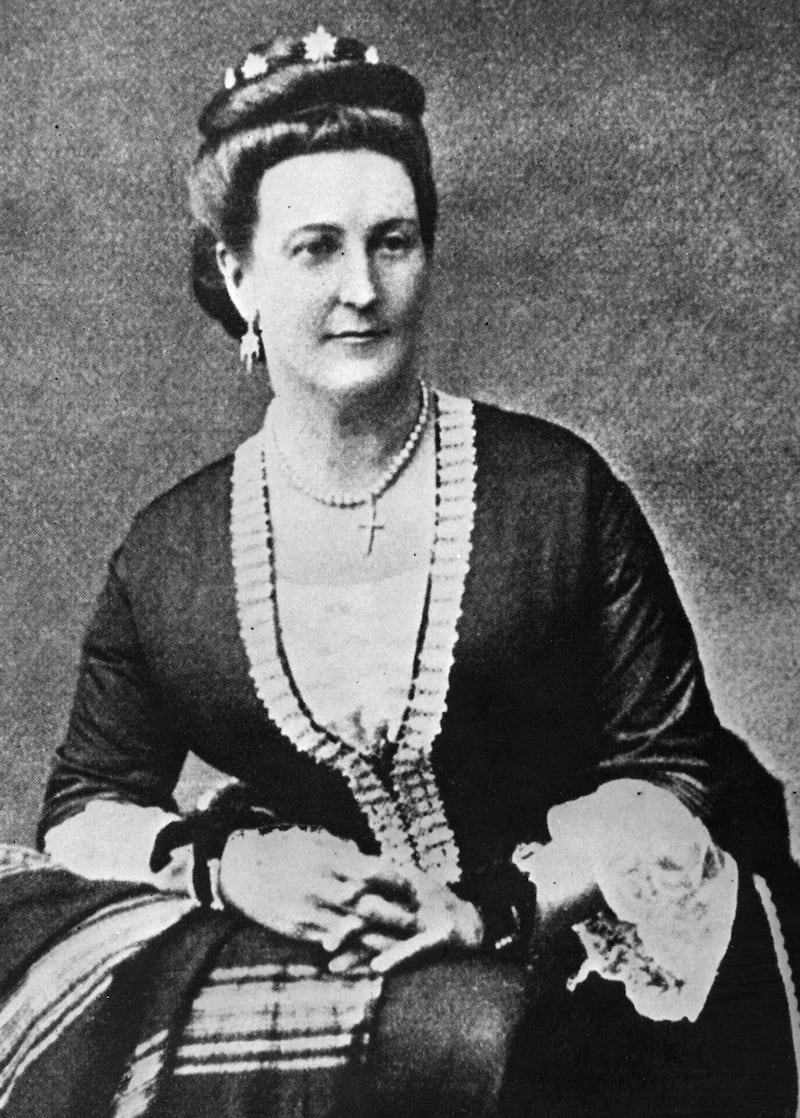
"circa 1869: Lady Isabel Burton (1831 - 1896), a travel writer and wife of English explorer Sir Richard Burton.
Hulton Archive/GettyShe then proceeded to organize the funeral of the century. Multiple services were held in Trieste, Italy, where Burton had died, and back in London where he would be buried. They were full of pomp and circumstance—and also all very Catholic.
“Many of Burton’s friends and family were outraged by what they saw as a betrayal of his lifelong stance as a freethinker and a critic of the rituals and dogmas of Christianity,” Dane Kennedy writes in The Highly Civilized Man: Richard Burton and the Victorian World.
But as obscene as many found the religious celebrations of Burton’s life to be, the real shocker was still to come.
On June 19, 1891, Isabel publicly confessed in a letter in the Morning Post that she had burned her husband’s manuscript for The Scented Garden.
According to Rice, Isabel holed herself up in their Trieste home for 16 days following her husband’s death and meticulously went through all of his papers.
It is believed that letters, manuscripts, and some journal entries were burned, though the extent and contents of the bonfire have been debated. But what is not in question is that the only copy of Burton’s The Scented Garden went up in flames.
In her letter to the paper many months later, Isabel claimed the crisis was brought on by a London publisher who offered her six thousand guineas for rights to the erotic manuscript.
She recounted the moral quandary she found herself in, believing that, “out of fifteen hundred men, fifteen will probably read it in the spirit of science in which it was written; the other fourteen hundred and eighty-five will read it for filth’s sake.” It would threaten to tarnish her husband’s reputation not only on the Earth he left behind, but possibly in the afterlife when he was but a “poor soul” forced to answer for its deeds “standing naked before its God.”
“Not only for six thousand guineas, but not for six million guineas will I risk it,” she declared in her chosen and very public forum for confession.
The backlash against her literary sin was fierce. Isabel received anonymous hate mail and condemnation from her husband’s friends, including the famed British writer Ouida. “The world and I are at daggers drawn,” she wrote to the London publisher Leonard Smithers.
While her stated and commonly accepted reason for the blaze was to protect the reputation of her husband, Kennedy notes that there is a reason other than the good of his soul that Isabel may have committed this act: to help ensure her financial security.
Burton had left his wife nearly penniless when he died, but Isabel was sitting on a treasure trove of publication rights. Throughout his life, Burton had periodically been at odds with England’s National Vigilance Association, which had the right to stop publication in its tracks if they deemed a text immoral.
Kennedy writes that Isabel may have been trying to prove to the sanctimonious Victorians that she was a “responsible” executor of her husband’s legacy and therefore should be able to publish his other works without their interference.
There was also that pesky problem of the notorious twenty-first chapter. Missing from the French translation, the final chapter of the original book is thought to have explored gay sex. While it is unknown if the copy Burton recovered from Algiers contained this chapter, rumors swirled that his new translation was complete.
If so, it wouldn’t be a stretch to imagine Isabel’s concern that it would add fuel to the whispers of experimentation that had surrounded her husband’s life.
Whatever Isabel’s reason, the bonfire of The Scented Garden mired the end of both her husband’s life and her own in scandal. In 1896, Isabel died, taking her place in the expedition tent beside her beloved.
How was eternity for both of them? As Isabel wrote, reflecting on the notorious act that would shadow her own legacy: “Will he rise up in his grave and curse me or bless me? The thought will haunt me to death.”