Early in The Brink of War, United States Secretary of State George Shultz (J.K. Simmons) remarks that being underestimated is a tactical advantage. Though he’s explicitly speaking about his boss, President Ronald Reagan (Jeff Daniels), his comment applies, to some degree, to the film in which he co-stars.

Writer/director Michael Russell Gunn’s drama about the October 1986 Reykjavik summit between Reagan and General Secretary of the Communist Party of the Soviet Union Mikhail Gorbachev (Jared Harris) over nuclear disarmament is a serviceable history lesson whose hagiographic earnestness is offset by understated turns from its leads and a persuasive pro-democracy, anti-communism attitude.
Like this May’s Pressure, its tale is merely a minor piece of a major whole—told well if, unavoidably, with a somewhat inflated sense of its own importance.
The Brink of War (August 14, in theaters) opens inauspiciously with the biblical quote, “Blessed are the peacemakers for they are the children of God”—a sentiment that suggests this Angel Studios release is after holy lionization. That may be true to some extent, though when it introduces Reagan staring out at a stormy sea at the conclusion of his thirty-hour summit with Gorbachev, his first words are, “I failed.”
This disappointment, he tells Shultz, came about because of one word (which won’t be heard until the film’s conclusion), after which Shultz beseeches Reagan to salvage the meeting by inviting Gorbachev to Washington because what happened in that room can’t “destroy our future.”
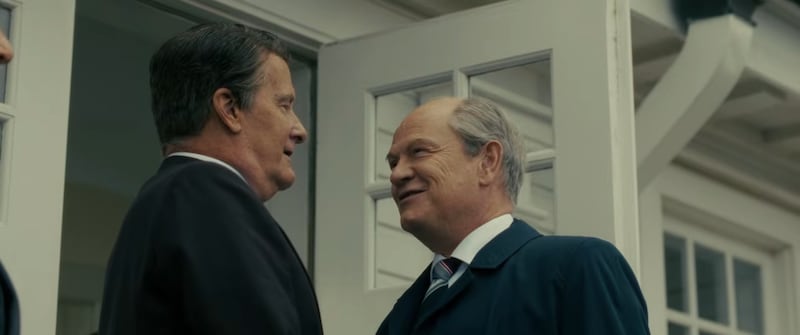
The Brink of War thus establishes its momentous global stakes before flashing back to this event’s commencement, with Reagan and Shultz arriving at the remote house—a former French consulate and British embassy—where they intend to sit down with Gorbachev in the hope of brokering an end to the ongoing arms race.
This locale is apparently haunted, yet that detail is one of many that’s included simply for color; when it comes to thematic depth, the proceedings are rather shallow. Everything is on the surface as the duo begins their chat. Simultaneously, the CIA and KGB set up shop in the basement—a piece of floor tape separating their spaces—and Gorbachev’s wife Raisa (Branka Katić) embarks upon an Icelandic PR tour during which she makes passive-aggressive remarks to NPR reporter Cleo (Anya Cash) and The Times journalist Alexander (Guy Burnet) about Nancy Reagan’s (Hope Davis) conspicuous absence from this conference.
Davis’ sneering first lady is the most unintentionally amusing component of The Brink of War, given that she’s relegated to sitting at home seething with fury at having been left behind—sentiments she suppresses when supportively talking to her husband on the phone.

Nancy and Raisa’s participation in the film is transparently ornamental, designed to flesh out a story that primarily involves two men sitting across from each other at a small table, hashing out a possible world paradigm-altering deal. The same goes for the squabbling of the CIA and KGB, whose barbs (lobbed at each other while they wait to use their respective restrooms) are clunky vehicles for elaborating on current US-USSR tensions.
Such superficiality, fortunately, doesn’t extend to Daniels and Harris, who approach their characters not as icons or cartoons but as committed, conflicted individuals struggling to find a way to uphold their ideals and protect their interests at the same time that they reach for compromise.
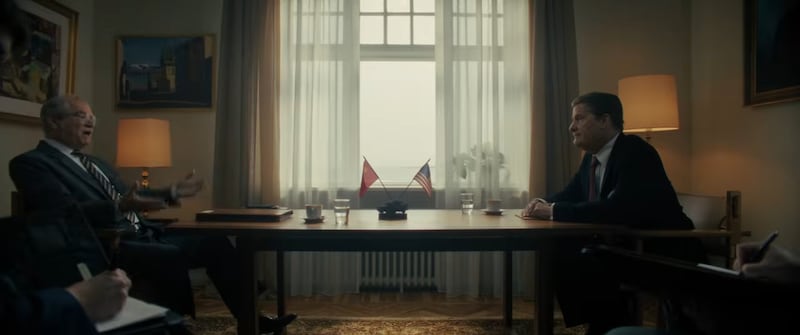
The facial prosthetics Daniels sports to resemble Reagan are a distracting mistake, especially considering that Harris is convincing without any such make-up. Nonetheless, the actor’s evocation of the president’s voice is subtle, and his rah-rah confidence is tempered by a sincere longing for peace through collaboration (thereby refuting his reputation as a “warmonger”) and, also, by his realization that his window of opportunity for negotiating an agreement is short—an understanding born from his brush with death courtesy of would-be assassin John Hinckley Jr. (which plagues his dreams) and a trembling hand that foreshadows oncoming health problems.
Embodying a conservative who’s a far cry from his The Newsroom protagonist, Daniels makes Reagan a man who’s equally resolute and flexible. A kindred spirit, Harris’ Gorbachev arrives in Reykjavik with a desire to talk about arms reduction, setting a tentatively hopeful tone for their ensuing conversation. For Reagan, that subject, which soon extends beyond intermediate-range ballistic missiles to nuclear warheads, is of significant import.
So too, however, is the topic of human rights and, in particular, Soviet citizens’ freedom (or lack thereof) to emigrate to America. That discussion revolves around famed cellist, conductor, and Soviet defector Mstislav Rostropovich, whose sister wants to visit the U.S. for her sibling’s birthday, and it eventually leads to heated squabbles that threaten to derail the endeavor.
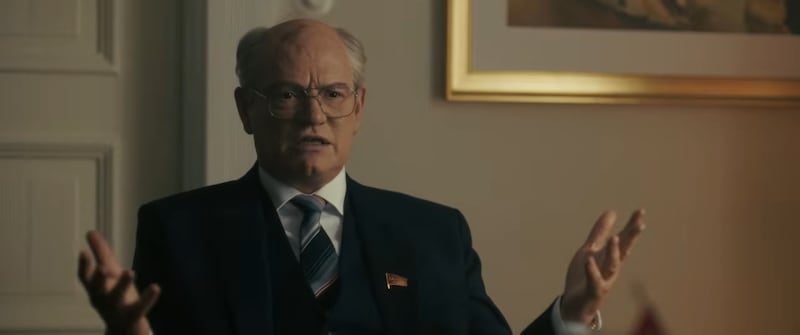
As anyone with an elementary school education knows, the Reykjavik get-together didn’t end the Cold War; that turning point arrived three years later with the fall of the Berlin Wall (at which Rostropovich played). Even so, it was a key step along the path to that defining moment, and The Brink of War dramatizes it with modest intensity, its action seesawing between Reagan and Gorbachev locating common ground with regard to nuclear disarmament and then retreating to hostile positions when the dialogue shifts to slandering the other’s country and its ideas about strength, security, and freedom. The proceedings rarely get to the level of pulse-pounding, but as far as diplomatic head-to-heads go, they’re relatively accurate and moderately engaging.
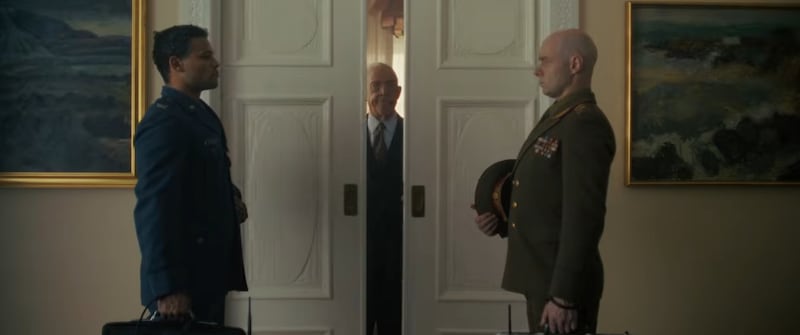
Reagan’s doubt and fear are foregrounded as The Brink of War wends its way back to its beginning, at which point it reveals that the commander-in-chief’s motives weren’t as obvious as he let on to his adversary. This twist is the most memorable component of Gunn’s film, if only because it’s the sole time someone turns out to be more (or less) than they appear. And Daniels’ assured performance allows it to resonate as a natural outgrowth of the president’s core beliefs.
There’s no ignoring the material’s pro-Reagan politics. He’s cast as a canny leader who saved the world from annihilation by strategically employing both force and cunning to achieve his ends. Still, its bias doesn’t unduly interfere with its serviceable portrait of a meeting that, in its own small way, helped usher in a post-Soviet reality.