

Conservative Supreme Court Justice Samuel Alito raged at his liberal colleague’s “baseless and insulting” dissent in an unusual ruling that speeds up the timeline of a decision benefitting Republicans.

Normally, the parties in a Supreme Court case must wait 32 days for a ruling to be certified and sent back to a lower court.
But on Monday, the court’s conservative justices granted an extraordinary request from Louisiana Republicans, allowing them to immediately take advantage of last week’s ruling gutting the Civil Rights Act, as they seek to eliminate the state’s two majority-Black congressional districts in time for November’s midterm elections.

In her dissent, Justice Ketanji Brown Jackson blasted the court’s decision to upend its default procedures and “facilitate Louisiana’s midstream redistricting rush,” despite primary ballots having already gone out to military and overseas voters.
Normally, the court frowns upon last-minute changes to election procedures, but in this case, it “dives into the fray” in a way that’s “unwarranted and unwise,” she wrote.
In a concurring decision, Alito fumed that Jackson’s dissent had accused the majority of “an unprincipled use of power,” which he claimed was “baseless and insulting” as well as “a groundless and utterly irresponsible charge.”
“The dissent accuses the Court of ‘unshackling’ itself from ‘constraints.’ It is the dissent’s rhetoric that lacks restraint,” he fumed.
Justices Clarence Thomas and Neil Gorsuch signed to the concurrence.
In her dissent, Jackson pointed out that the court had waived the 32-day rule just twice in the last 25 years.
“The Court’s decision to buck our usual practice… is tantamount to an approval of Louisiana’s rush to pause the ongoing election in order to pass a new map,” she wrote.
The original case, Callais v. Louisiana, struck down Louisiana’s political map and set off a rush across the South to overturn maps that had been drawn to comply with the Voting Rights Act, the Civil Rights-era law restricting racial gerrymandering and racial discrimination in voting in former Jim Crow states.
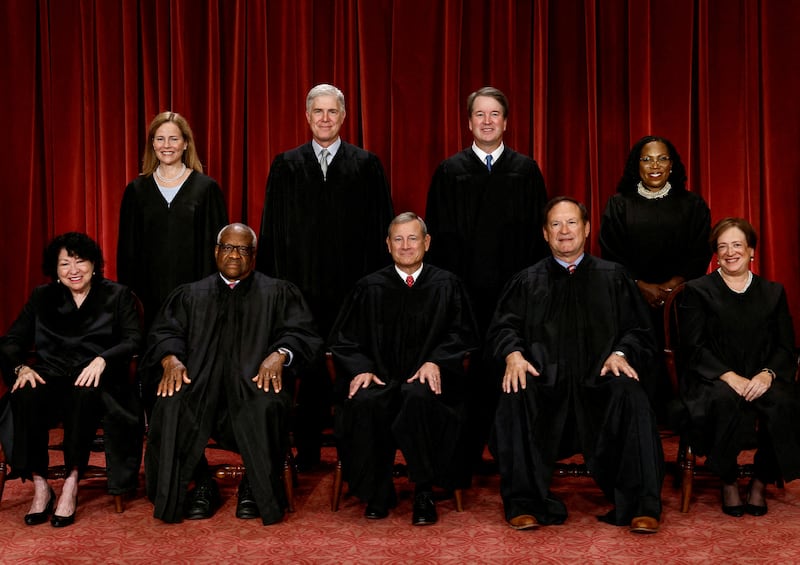
But it didn’t address the legal and political questions involved in suspending an ongoing election, Jackson wrote in her dissent.
She and liberal colleagues, Elena Kagan and Sonia Sotomayor, joined a fiery dissent in the Callais case, with Kagan writing that the ruling represented the “latest chapter in the majority’s now-completed demolition” of the VRA.
Neither Kagan nor Sotomayor, however, signed on Jackson’s dissent in Monday’s decision.
The angry written exchange between Jackson and Alito comes as the disagreements between the court’s liberal and conservative blocs have become more frequent, more public, and more personal.
Both Jackson and Sotomayor have spoken out against the court’s reliance on the so-called shadow docket, which has allowed Trump to continue implementing his agenda even as lower courts have ruled his policies are unconstitutional.
Last month, Sotomayor also accused Kavanaugh of being out of touch with reality after he wrote in a concurrence that immigration agents could target people based on a combination of factors, including their race, language, and where they worked.

She later apologized for saying that her colleague—who lives in a $1.6million home in affluent Chevy Chase, Maryland—probably doesn’t know any hourly workers, and doesn’t realize that even if those stops are temporary, they can mean the difference between a parent being able to put food on the table that night or not.