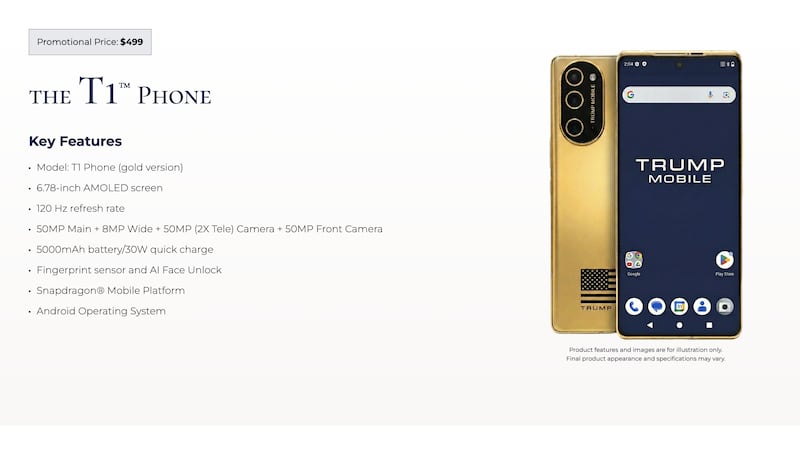
Donald Trump’s flagship MAGA phone appears to be a nearly part-for-part replica of another cellphone announced by a Taiwanese company exactly two years ago.
NBC News took one of the president’s long-awaited Trump Mobile T1 phones to iFixit, a California repair company that publishes detailed teardowns of mobile gadgets, to take a peek at its inner workings.
Network reporter Brian Cheung, in a segment on the test published Thursday, said a scan revealed how the Trump phone, which retails at $499, “looked eerily similar” to another scan of Taiwanese group HTC’s U24 Pro, released in June 2024.
“Without cheating, tell me which one’s which,” iFixit analyst Shahram Mokhtari asked Cheung about the two scans as they were displayed on dual monitors.
“Wow, they look so similar!” Cheung exclaimed, explaining that the boards, batteries, and vertically aligned trio of cameras on both phones are “mostly in the same place.”

The only outward difference appears to be the placement of the Trump phone’s flash function. Further analysis confirmed that the parts are otherwise “nearly identical.”
“Everything we’ve seen suggests that the T1 was manufactured in the same factory,” Mokhtari concluded.

Trump Mobile has had a rocky road to the device’s release. The company, controlled by the president’s sons Eric and Donald Trump Jr., proudly announced at the group’s launch last June that the phones would be “MADE IN AMERICA.”
That boast disappeared from the website just days later, to be replaced with the decidedly more modest claim the devices would be “brought to life right here in the USA” with “American hands.”
Further revisions followed in April. The company updated its website to now market the phone as “designed with American values in mind,” having been “shaped by American innovation” with “American teams helping guide design and quality.”
The phone was finally released in May, nine months behind schedule.
The problems also extend far beyond the factory floor. The group also appears to have left buyers’ home addresses and emails sitting in an unsecured online database, cybersecurity firm UpGuard reported earlier in May.

UpGuard put the number of people hit at roughly 30,000 and graded the incident “medium severity,” warning that the open home addresses raised the risk of phishing and unwanted visitors.
It called the leak an accidental exposure, not a deliberate hack, and said the company went quiet after being alerted, keeping the database live.
The Daily Beast has contacted Trump Mobile and HTC for comment on this story.