Tucker Carlson insisted he never suggested President Donald Trump could be “the Antichrist,” despite a recording proving he had.
During a nearly two-hour sit-down with The New York Times for its podcast The Interview, host Lulu Garcia-Navarro pressed Carlson on his fiery commentary about Trump, specifically whether he had suggested the president could be the Antichrist.
“I have not said that,” Carlson replied.
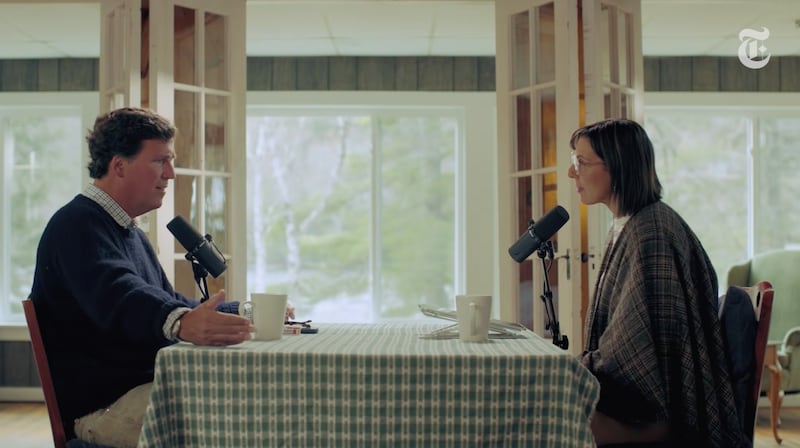
Garcia-Navarro then read back Carlson’s own words from a broadcast of his show.
“Here’s a leader mocking the gods of his ancestors… Could this be the Antichrist?” she quoted to him.
“I actually did not say ‘could this be the Antichrist,’” Carlson insisted.
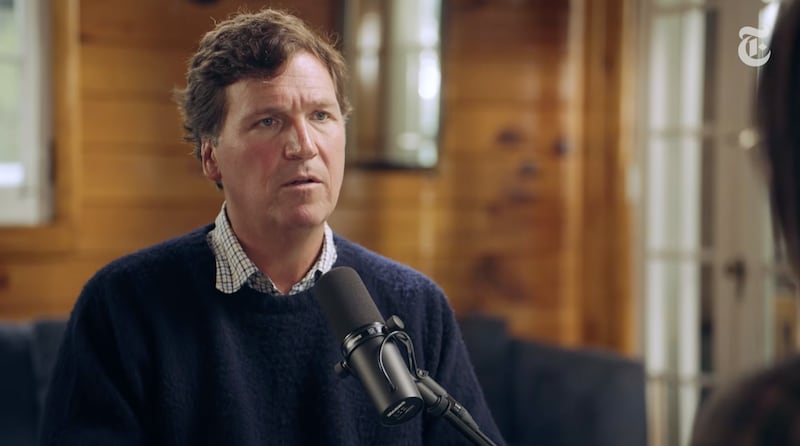
“I don’t know where that comes from, but I know that those words never left my lips because I’m not sure I fully understand what the Antichrist is.”
The Times then played a clip of him saying exactly that, shown in a video released alongside the interview.
The exchange quickly became a defining moment of the interview.
In an accompanying write-up, Garcia-Navarro described Carlson as leaning heavily into spiritual explanations for political events, repeatedly invoking “unseen forces” and suggesting Trump’s influence over those around him could be “spellbinding.”
“I think it probably literally is a spell,” Carlson said.
“You spend a day with Trump and you’re in this kind of dreamland. It’s like smoking hash or something.”

Once one of Trump’s most prominent media allies, Carlson said the breaking point came over the administration’s decision to strike Iran, which he vehemently opposed.
He told the Times he now regrets his past support of Trump and acknowledged he had harbored private doubts about the current president for years.
“Did I have reservations about Trump? Of course. To some extent, I sublimated them or rationalized them away or focused on areas where I agreed with him,” Carlson said.
“All my fault. But I told myself—and I to some extent still believe—it’s the big decisions that matter."
Carlson’s critique is hardly straightforward. In the same interview, he portrayed Trump as both morally culpable and a kind of captive, calling him a “slave” to geopolitical pressures while also suggesting that those around him were either too fearful or too in his thrall to resist.
The interview veered further into the surreal at times as Carlson floated what he himself called a “probably insane” theory that people in Trump’s orbit had been mysteriously harmed.
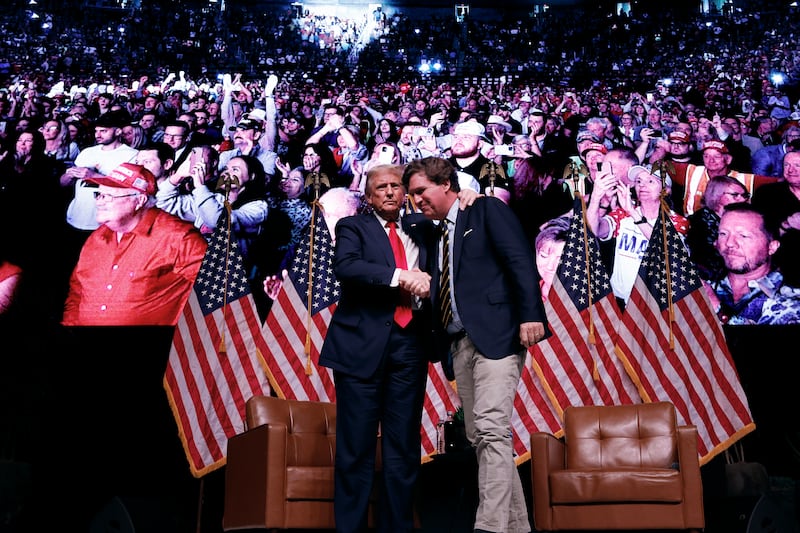
“I have a lot of thoughts and theories about things which may or may not be rooted in reality,” he said.
“But one thing that has bothered me for many years is the fact that a lot of people in Trump’s immediate orbit have been hurt—and really hurt. Gone to prison, become unemployable, publicly shamed, have gotten cancer.
But even as Carlson seemed comfortable draping himself in spiritual language, he was insistent on distancing himself from his previous “Antichrist” remark when the exchange resurfaced later in the interview.

“I just want to make the point that you did say, ‘Could this be the Antichrist?’ and then you said, ‘Well, who knows?’” Garcia-Navarro said.
“Then my apologies to you, if there’s a video of me saying that,” Carlson replied.
“I guess what I’m expressing to you is [that] it doesn’t reflect exactly how I feel. It suggests a precision that I haven’t arrived at, that Trump is the Antichrist.”