Trump Is a Walking, Talking National-Security Danger
After two years of Mueller’s investigation, Trump still doesn’t understand that accepting foreign help in elections is illegal. It’s also a recipe for blackmail.
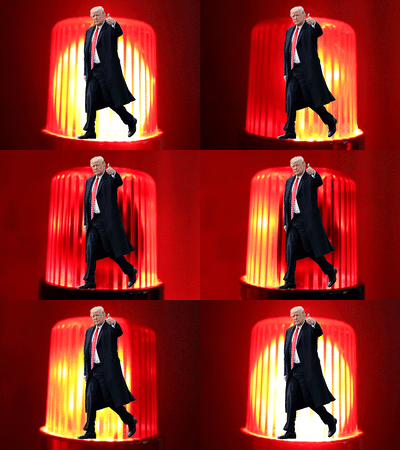
Photo Illustration by Sarah Rogers/The Daily Beast / Photos Getty
After two years of investigations, President Donald Trump remains unconvinced that there is anything wrong with accepting help from a foreign government to win an election.
During a television interview with ABC’s George Stephanopoulos, Trump said he would not tell the FBI if he were offered information on a political opponent from a foreign government. He said “Give me a break, life doesn’t work that way.” When reminded that FBI Director Christopher Wray has said that candidates should report contacts from foreign governments, Trump said, “The FBI director is wrong.”
Trump later conceded that “maybe” he would go to the FBI if he thought that “something was wrong,” but only after he met with the foreign representative to listen.
Trump spoke in the context of defending his son Donald Trump Jr., who was interviewed yesterday by the Senate Intelligence Committee. Among the topics Trump Jr., was expected to discuss was a meeting with Russians in June 2016.
Even sitting down and listening to an overture from a foreign government puts a candidate at risk of blackmail.
According to special counsel Robert Mueller’ report, Trump Jr., accepted an offer communicated to him by email to meet with Russians to receive “some official documents and information that would incriminate Hillary [Clinton] and her dealings with Russia and would be very helpful to your father.” The email further stated, “This is very high level and sensitive information but is part of Russia and its government’s support for Mr. Trump..." Trump Jr. famously responded to the email by replying, “If it’s what you say, I love it....”
The meeting took place a few days letter, attended by Trump Jr., as well as campaign chair Paul Manafort and Trump’s son-in-law, Jared Kushner. The meeting participants say that they did not receive any of the kind of information that had been promised.
Get the best of The Beast delivered right to your inbox
By clicking “SUBSCRIBE” you agree to our Terms of Use and Privacy Policy.
As Mueller’s report notes, however, the United States has a “compelling interest” in preventing “foreign influence over the U.S. political process.” For that reason, U.S. law prohibits foreign nationals from making donations in connection with elections, and prohibits any person from accepting soliciting, accepting, or receiving a “donation of money or other thing of value” from a foreign national in connection with an election. In other words, we don’t want foreign governments or individuals having any say in who wins our elections because we are a self-governing democracy in which only American citizens get to vote and influence the outcome of elections.
The federal statute has two specific requirements: The violation must be willful, that is, the person must know that his conduct is illegal. In addition, the value of the contribution must exceed $25,000. Mueller found insufficient evidence in this case to establish either of these elements. He was unable to show that Trump Jr., Manafort, or Kushner knew about the legal prohibitions on foreign contributions. He was also unable to put a dollar value on the promised opposition research, in part because it never materialized.
In light of public attention to the law that accepting a thing of value from a foreign national is illegal, Trump would be unable to hide behind a lack of willfulness defense in the future.

The failure to prove these two elements should not obscure what Mueller did show: that high-level members of the Trump campaign were willing to accept assistance from a foreign government. Even if the conduct did not technically violate the law, it violated every rule of national security.
In addition to permitting foreign actors to have a say in the outcome of our nation’s democratic election, the Trump campaign also exposed itself to foreign influence. This threat is why Trump’s new comments are so alarming. Even sitting down and listening to an overture from a foreign government puts a candidate at risk of blackmail. Many intelligence operations are based on offering someone something that they want–money, access, sex–and then using that enticement as a trap to coerce compliance with demands. The foreign adversary doesn’t even need to say out loud that it will expose the person’s betrayal to his country. The mere knowledge that the foreign government could expose a person’s unpatriotic acts may be sufficient leverage to induce someone to act in the best interests of the adversary and contrary to the best interests of his own country. The meeting alone compromises the candidate.
Trump compounded the harm of the meeting with Russians by editing a press statement about the incident to omit any reference to the purpose of the meeting: to share information about Clinton. This act further compromised him with Russia because it created an additional opportunity for them to leverage against him his lie to the American people.
Trump’s comments that he would listen, and report to the FBI only if something was wrong, is wrong as a matter of good counterintelligence practice, and profoundly wrong as a matter of patriotism.
See more of our coverage in your search results.

Got a tip? Send it to The Daily Beast here.
Register below to read this article for free or subscribe
to unlock unlimited access to The Daily Beast.
Monthly
$1
First month then $5.99/month
Annual
$35
First year then $59.99/year
Premium
$79
First year then $119.99/year
*Substack access provided by the next business day, using your subscription email. Choosing the Premium plan constitutes your permission to share your subscription email with Substack and your agreement to Substack’s Privacy Policy.
Already have an account? Sign In
Looks like you already have a subscription!
You're all set!
Thanks for subscribing.